Benedictine College Library: Granite and Bronze Fountains for a Classical Campus in Atchison, Kansas
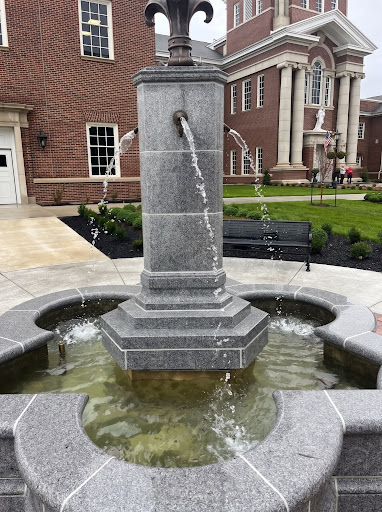
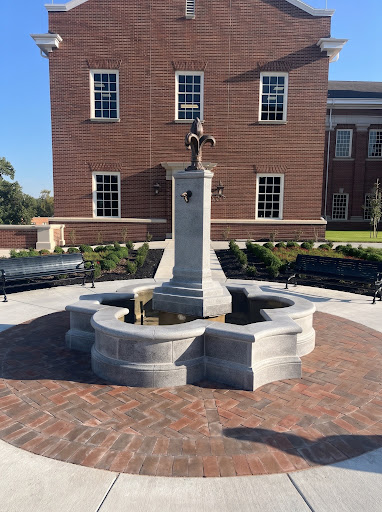
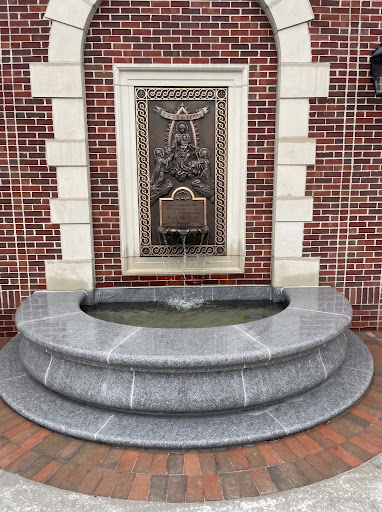
Roman Fountains and our long-time partner, Rock’N Crab LLC, created a pair of granite and bronze fountains for the Benedictine College Library in Atchison, Kansas. A freestanding courtyard fountain with a bronze fleur-de-lis finial and a wall fountain with a bronze relief panel give the Independence Hall-inspired building water features that match its classical brick and stone architecture.
The library, known as the Moritz Library in D’Aniello Hall, was completed in 2026 and dedicated on September 26, 2026.
This case study covers the design goals for the fountains, the details of each one, and the materials that make them fit the campus. It also shows what the project means for landscape architects and campus owners planning classical or traditional water features.
About the Benedictine College Library
Benedictine College is a Catholic, Benedictine liberal arts college on the bluffs above the Missouri River in Atchison, Kansas. Its new library is the academic center of the campus, and its design draws on classical architecture and on Independence Hall in Philadelphia.
- Size: The building is approximately 58,000 square feet.
- Architecture: A brick and stone exterior with columns, a bell tower, and a copper dome and spire modeled on Independence Hall.
- Spaces: Study areas, a growing collection, and a museum-quality replica of the Independence Hall Assembly Room.
- Opening: The library was completed in 2026 and dedicated on September 26, 2026.
The fountains sit within the surrounding campus landscape, where brick paving, plantings, and benches extend the character of the building outdoors.
Designing Fountains That Belong to the Architecture
A classical building calls for water features with the same discipline and detail. The goal for the Benedictine College fountains was a pair of pieces that look as though they have always been part of the campus, and that run reliably for the students, faculty, and visitors who use it every day.
Four design priorities shaped the work.
- Material harmony: Granite and bronze were chosen to sit comfortably beside the library’s brick, stone, and copper details.
- Traditional form: Each fountain uses classical vocabulary, including a pedestal, a shaped basin, a finial, and a carved niche.
- Places to gather: Benches, plantings, and brick paving around the courtyard fountain turn it into a place to pause, as well as a feature to look at.
- Dependable operation: Public campus fountains need equipment that runs consistently with little attention from facilities staff.
We worked with the project’s architect and designer, and with our long-time partner Rock’N Crab LLC, to bring these priorities together.
The Two Fountains
The project includes two fountains that work as a pair. One stands in the open as a focal point, and the other is set into the building wall as a quiet detail.
The Courtyard Fountain
The courtyard fountain is a freestanding granite piece. Its basin has a four-lobed, quatrefoil shape, and a stepped octagonal base carries a tall granite pedestal topped with a bronze fleur-de-lis finial. Bronze spouts on the pedestal send arcs of water into the basin, and additional water action rises within the basin itself. The fountain sits in a circle of brick pavers, with benches and planting beds around it.
The Wall Fountain
The wall fountain is set into an arched brick niche framed in stone. A bronze relief panel with an ornate border and an inscription forms its centerpiece. Water spills from a small bronze basin at the base of the panel and falls into a half-round granite basin below, which sits on a stepped granite base over a brick paver apron. The scale is intimate, and it rewards visitors who stop to look closely.
Materials and Craftsmanship
Granite and bronze are traditional fountain materials, and they suit this project for good reason. Both are valued for how they look and age outdoors, and both pair naturally with brick and stone.
- Granite: The basins, steps, pedestal, and coping are cut granite with a fine, consistent finish and clean joints between pieces.
- Bronze: The fleur-de-lis finial, the spouts, and the relief panel add warm, detailed accents that contrast with the cool gray stone.
- Setting: Brick pavers, stone framing, benches, and plantings tie each fountain into its surroundings.
- Water effects: Arcing spouts and gentle bubbling in the basins give each fountain movement and sound without overpowering the architecture.
The quality of the finished work is visible in the details, and it reflects the care of everyone who worked on the project.
Working With Our Long-Time Partner, Rock’N Crab LLC
We delivered the Benedictine College fountains alongside Rock’N Crab LLC, a long-time partner of Roman Fountains. A relationship built over many projects gives a team shared standards, a common way of working, and the ability to solve problems quickly when a detail needs attention. On a project where the finish and fit matter as much as they do here, that experience shows.
We are grateful to Rock’N Crab LLC for their part in this project.
What the Architect and Designer Said
Thank you again for your work with us on the Benedictine College fountains, they have turned out beautifully and it seems all the equipment is working well!
Architect/Designer, Benedictine College Library Project
Feedback like this is the measure we value most. A fountain needs to look right on opening day, and it needs to keep running well afterward. Both matter to the architects and owners who rely on us.
What This Project Shows Landscape Architects and Campus Owners
The Benedictine College fountains offer several lessons for anyone planning water features for a traditional or classical setting.
- Match the vocabulary of the architecture: Pedestals, shaped basins, finials, and carved niches let a fountain read as part of the building’s design.
- Coordinate materials across the site: Granite, bronze, brick, stone, and plantings work best when they are chosen together.
- Layer the experience: A freestanding fountain and a wall fountain give a campus both a focal point and a quiet, close-up detail.
- Plan the equipment early: Vault locations, utilities, and access are easiest to coordinate while the design is still open.
If your next project calls for a classical, traditional, or custom fountain, our design team can help you develop it from concept through installation.
More Campus and Institutional Projects
Explore other college, university, and institutional projects from our portfolio.
- Assumption College features a fountain on a college campus in Worcester, Massachusetts.
- DePauw University Stewart Plaza is a university plaza fountain in Greencastle, Indiana.
- Belmont University Performing Arts Center includes fountains at a university performing arts venue.
- Mercer University is a university water feature design project.
- Sacred Heart Catholic Church Baptismal Font is a baptismal font design project.
Plan Your Campus Fountain With Us
If you are designing a library, quad, entry, or courtyard that calls for a fountain, bring us in while the concept is still flexible. Our design team can review your site, recommend features that suit the architecture, and provide the engineering details your project needs.
Quick Answers
What fountains did Roman Fountains create for the Benedictine College Library?
Roman Fountains and Rock’N Crab LLC created two granite and bronze fountains for the library in Atchison, Kansas. One is a freestanding courtyard fountain with a quatrefoil basin and a bronze fleur-de-lis finial, and the other is a wall fountain with a bronze relief panel and a half-round granite basin.
Who is Rock’N Crab LLC?
Rock’N Crab LLC is a long-time partner of Roman Fountains, and they were part of the team on the Benedictine College fountains.
Where is the Benedictine College Library?
The library is on the campus of Benedictine College in Atchison, Kansas. It is known as the Moritz Library in D’Aniello Hall.
What materials are the fountains made from?
The fountains use granite for the basins, steps, pedestal, and coping, and bronze for the finial, spouts, and relief panel. Brick pavers and stone framing complete the setting.
Why use granite and bronze for a campus fountain?
Both materials are traditional choices that age well outdoors and pair naturally with brick, stone, and copper. They suit the classical architecture of the library.
Can Roman Fountains design custom or traditional fountains for campuses?
Yes. Our design team works with landscape architects, architects, and campus owners to develop custom and traditional fountains, from concept through installation.